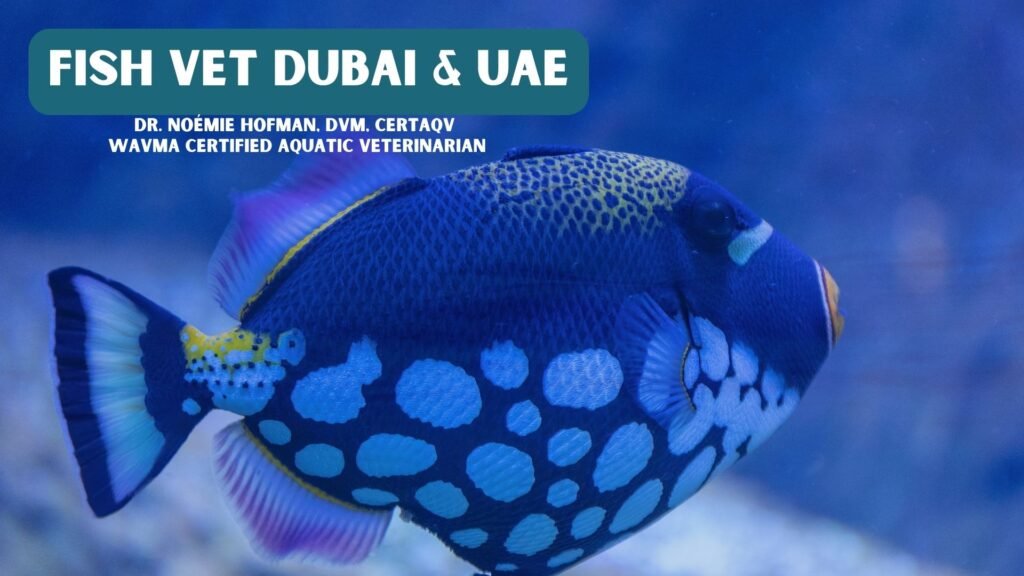
Veterinary care for pet fish, koi and aquatic animals in Dubai
If you are looking for a veterinarian for your fish in Dubai or the UAE, you may already have discovered that finding veterinary care for aquatic animals can be difficult.
I’m Dr Noémie Hofman, DVM, CertAqV, an exotic, aquatic and wildlife veterinarian based in Dubai and a WAVMA Certified Aquatic Veterinarian.
Aquatic veterinary medicine is one of the main areas of my clinical work. I see ornamental fish and other aquatic patients for medical problems ranging from changes in behaviour, appetite or swimming to skin and gill disease, abnormal buoyancy, masses, wounds and more complex conditions requiring diagnostic imaging, anaesthesia or surgery.
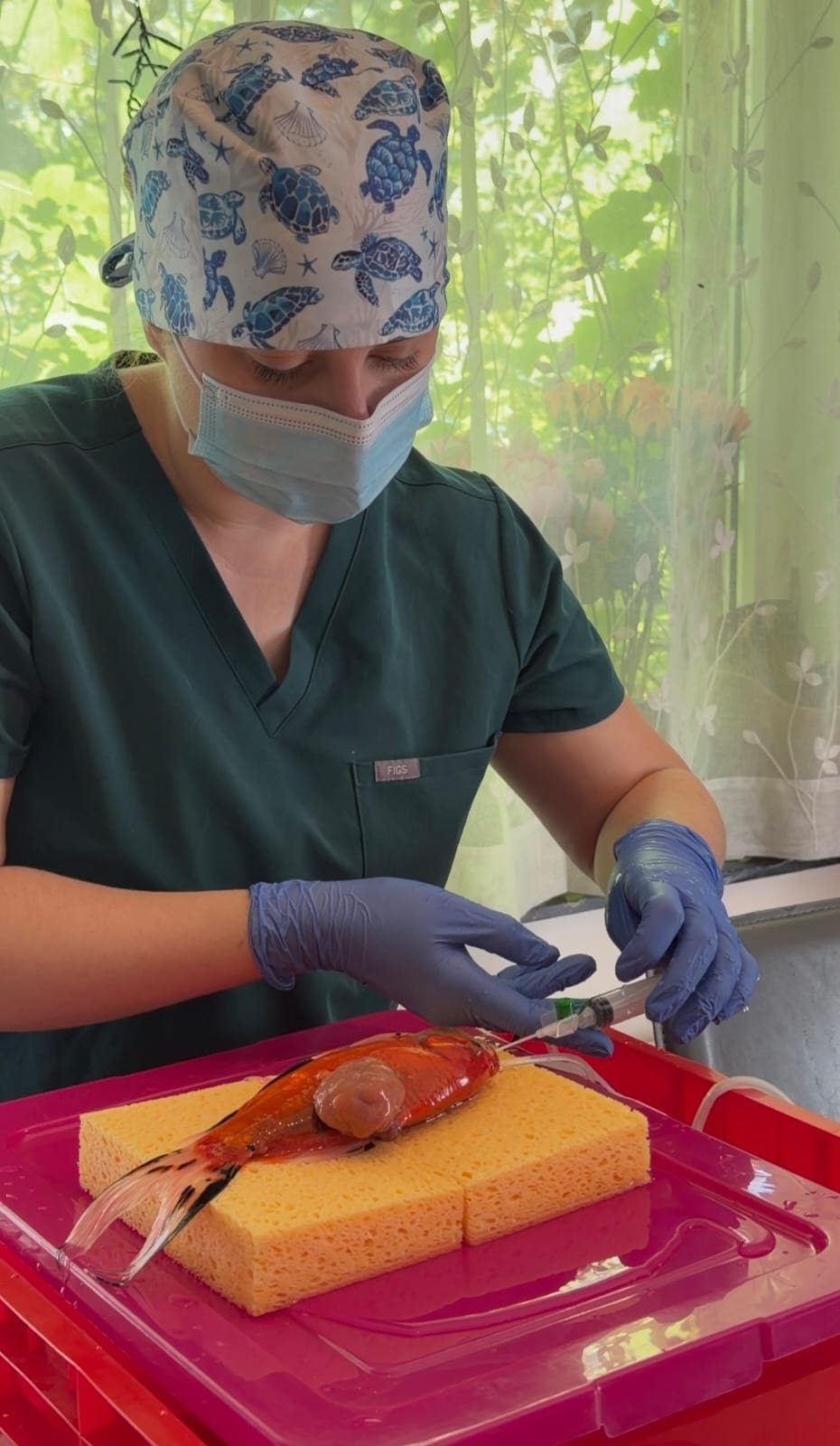
Fish can be investigated and treated as veterinary patients. Depending on the case, veterinary care can include physical examination, water-quality assessment, microscopy, cytology, diagnostic imaging, blood sampling, anaesthesia, surgery and medical treatment.
The challenge is working out why the fish is sick in the first place.
Meet Dr Noémie Hofman
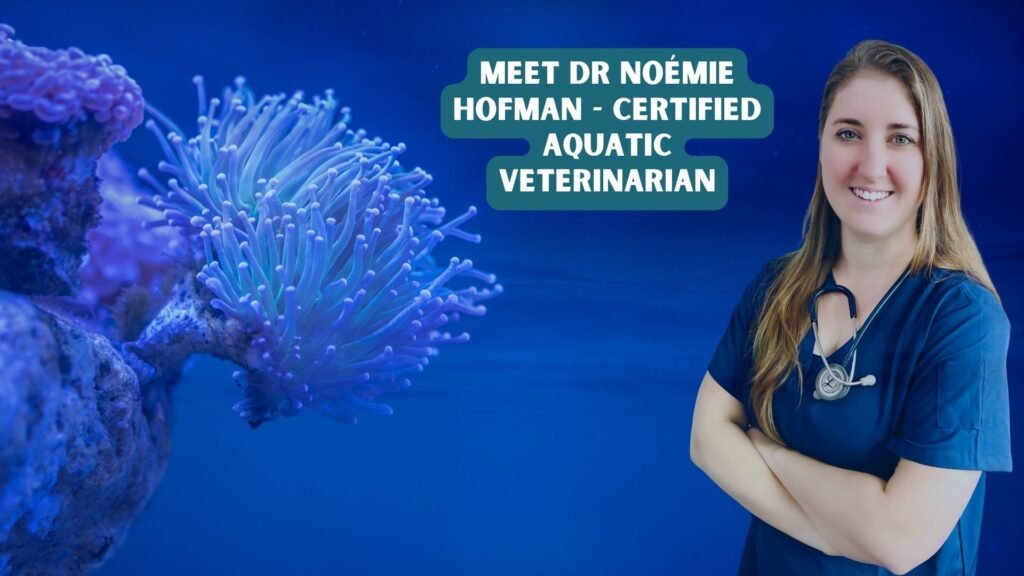
I’m a veterinarian with a particular interest in aquatic, exotic and wildlife medicine, currently practising in Dubai.
My work with aquatic animals combines individual patient medicine with an understanding of the environment they live in. A fish cannot be completely separated from their water, filtration, nutrition, stocking, temperature and the other animals sharing its system.
This is why a fish consultation may look slightly different from the veterinary appointment most owners are familiar with.
My aim is to make proper veterinary medicine more accessible to fish owners in Dubai and across the UAE, while helping owners understand what is happening to their animals and why particular investigations or treatments may be recommended.
What can an aquatic veterinarian do for a fish?
Many owners are surprised by how much veterinary medicine can be performed in fish.
Depending on the species, condition and individual case, veterinary investigation may include:
- complete history and assessment of the aquarium or pond
- physical examination
- water-quality assessment
- skin and gill sampling
- microscopy
- cytology
- blood sampling
- diagnostic imaging such as radiography and ultrasound
- anaesthesia
- biopsy
- medical treatment
- surgical procedures
- investigation of disease affecting multiple fish
- quarantine and biosecurity advice
The appropriate approach depends heavily on the patient. A koi living in a large outdoor pond presents a very different clinical situation from a betta living alone in a smaller aquarium.
What fish and aquatic animals do I see?
Veterinary care may be available for a wide variety of ornamental and aquatic species, including:
Freshwater ornamental fish (Koi, Goldfish, Betta fish etc.)
Marine ornamental fish (Tangs, eels, clownfish etc.)
Zoological institutions aquaria
Pond fish
Axolotls and other aquatic patients
If you are unsure whether I can see your particular species, please contact me with information about the animal and the problem you are seeing.
My fish is sick. Where do I start?
This is one of the most common questions I receive from fish owners.
A fish may show illness through changes that initially seem quite small:
- not eating
- swimming differently
- floating or sinking
- spending more time at the surface or bottom
- breathing differently
- developing white spots or changes to the skin
- wounds or ulcers
- swollen areas or lumps
- abdominal enlargement
- colour changes
- unusual behaviour
- separating from other fish
These signs can have many possible causes.
For example, a fish swimming abnormally is sometimes assumed to have “swim bladder disease.” Abnormal buoyancy can actually occur for several reasons, and identifying the underlying problem may require examination and further diagnostics.
Likewise, a swollen fish does not automatically have one particular disease, and white spots are not always caused by the same parasite.
This is why diagnosis comes before choosing treatment whenever possible.
Learn about fish health
I’ve created a growing library of articles for fish owners who want to understand their animals better.
You can start here:
Why is my fish sick? Common diseases in ornamental fish
Axolotl care: Common mistakes and how to avoid them
What does aquatic veterinary care actually involve?
Fish Surgery in Dubai: Yes, Fish Can Have Operations
Koi veterinary care in Dubai
Koi medicine can involve both the individual fish and the health of the entire pond.
A veterinary investigation may consider:
the affected koi → other fish in the pond → water quality → filtration and husbandry → recent introductions → previous treatments → infectious and non-infectious disease
Depending on the problem, examination can include skin and gill sampling, microscopy, diagnostic imaging, blood sampling, anaesthesia or surgery.
For collections and ponds where several fish are affected, understanding what is happening at population level becomes particularly important.
Read up about koi health in Dubai by clicking here
Frequently Asked Questions About Fish Veterinary Care in Dubai
Is there a veterinarian for fish in Dubai?
Yes. Fish can receive veterinary investigation and treatment in Dubai. I am Dr Noémie Hofman, an exotic and aquatic veterinarian based in Dubai and a WAVMA Certified Aquatic Veterinarian. I see ornamental fish and aquatic patients for a range of medical problems, including skin and gill disease, abnormal swimming or buoyancy, wounds, masses, changes in appetite and conditions requiring further diagnostic investigation.
When should I take my fish to a veterinarian?
A veterinary assessment should be considered by a certified aquatic veterinarian when you notice a persistent or significant change in your fish’s normal appearance or behaviour. This can include loss of appetite, abnormal swimming, difficulty maintaining buoyancy, changes in breathing, wounds, ulcers, white spots, swelling, lumps or unexplained deaths within an aquarium or pond.
Sudden deterioration, significant breathing difficulty, severe wounds or multiple fish becoming ill warrant particular attention.
Can I take a goldfish to the vet?
Yes. Goldfish can be examined, diagnosed and treated by veterinarians experienced in aquatic medicine. Depending on the problem, investigation may include examination, water assessment, microscopy, diagnostic imaging and other tests.
Do you treat koi in Dubai?
Yes. Koi can receive individual veterinary assessment, while disease affecting a pond may require investigation of the wider population and environment. Water quality, parasites, infectious disease, nutrition, husbandry and recent introductions may all be relevant.
Can fish have surgery?
Yes. Surgery can be performed in fish when clinically appropriate. Fish can be anaesthetised and maintained under anaesthesia while certain procedures are performed. I’ve explained the process in more detail in my fish surgery in Dubai guide.
Can you X-ray or ultrasound a fish?
Yes. Diagnostic imaging can be extremely useful in aquatic veterinary medicine. Radiographs and ultrasound can help investigate internal abnormalities that cannot be assessed from the outside of the fish alone.
Can fish have tumours?
Yes. Fish can develop both benign and malignant neoplasia as well as cysts and other masses. The appearance of a lump alone cannot tell us exactly what it is, so further investigation may be recommended depending on the location, species and condition of the patient.
My fish is swimming sideways. Does it have swim bladder disease?
Not necessarily. “Swim bladder disease” is commonly used as a description for fish with buoyancy problems, but abnormal floating, sinking or swimming can have multiple underlying causes. A veterinarian will consider the fish’s history, environment, physical findings and, where appropriate, diagnostic imaging or other tests.
My fish has white spots. Is it ich?
White spots can be associated with certain parasitic diseases, including Ichthyophthirius multifiliis in freshwater fish, but appearance alone does not always provide a definitive diagnosis. Microscopic examination of appropriate samples can help identify parasites and guide treatment.
Should I bring aquarium water to my fish’s appointment?
Yes. Water quality can provide important information when investigating aquatic disease and extra water from the tank is necessary if sedation is needed. Contact the veterinary team before your appointment for instructions on how much water to collect, where to collect it from and how to transport it.
How do I transport a sick fish to the veterinarian?
Transport requirements depend on the species, size of the fish, journey duration and condition of the patient. Temperature, oxygenation, water volume and minimizing unnecessary stress all need consideration. Contact the clinic before travelling so appropriate transport instructions can be given for your fish.
Do you treat axolotls in Dubai?
Yes, axolotls are aquatic amphibians rather than fish, but they can also require veterinary care. Problems involving appetite, skin, gills, buoyancy, trauma and inappropriate environmental conditions may require investigation.
Looking for a fish vet in Dubai?
If your fish, koi or aquatic animal is unwell, you can contact me to discuss veterinary assessment.
If possible, include:
Species:
Number of fish affected:
Main problem:
How long it has been happening:
Photographs/video:
Aquarium or pond information:
Any treatment already given:
Dr Noémie Hofman, DVM, CertAqV
WAVMA Certified Aquatic Veterinarian
Exotic, Aquatic & Wildlife Veterinarian
Dubai, United Arab Emirates